
What's included
A tender is a schedule made mostly of other people's time: bidders writing responses, panel members finding a free week, lawyers negotiating and an incumbent handing over. You control the start date and very little else:
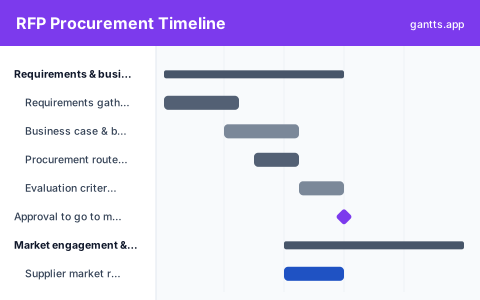
- Requirements & business case, Stakeholder requirements, business case and budget approval, the procurement route and threshold check, and the evaluation criteria and weightings, which must be fixed before anything goes out. Milestone: approval to go to market.
- Market engagement & documents, Market research, an optional RFI or prior information notice, the RFP document itself, contract terms and schedules, the scoring model, and confirming the evaluation panel and blocking their diaries. Milestone: tender pack approved.
- Open tender period, Issue, the bidder question window, a supplier briefing, the clarification deadline, published answers to all bidders, and the bid preparation time that follows. Milestone: submission deadline.
- Evaluation, Compliance check, technical and commercial evaluation in parallel, moderation to consensus scores, presentations, due diligence on the preferred bidder and the evaluation report. Milestone: award recommendation approved.
- Award, standstill & contract, Award and regret letters, the standstill or notice period, debriefs, final negotiation and signature. Milestone: contract awarded.
- Mobilisation & transition, Kickoff, transition from the incumbent, onboarding and access, governance and KPI reporting, and the date the service actually starts. Milestone: service commencement.
Who uses this template
Procurement leads, bid managers, and public-sector buyers use this to run a competitive tender without missing a statutory deadline. It maps requirements gathering, tender publication, the clarification and submission dates, evaluation, and any standstill period, giving suppliers a clear window and the buying team a defensible, auditable process from brief to mobilisation.
How to customize it
- Fix the submission deadline and the service commencement date first; both are usually externally driven and everything else fits between them.
- Check the minimum tender period and standstill duration for your jurisdiction and procurement route before using the durations shown.
- Block the evaluation panel's diaries at the same time you issue the RFP, panel availability, not evaluation effort, is what usually slips this phase.
- Add rows for site visits or reference calls if your evaluation includes them; they need supplier and referee availability, so treat them as scheduled work.
- Extend the transition phase substantially if an incumbent supplier is handing over data, staff or assets.
- Add a row per lot if the tender is divided, since evaluation and award can complete at different times per lot.
Scheduling tips
- Fix the evaluation criteria before issuing. Weightings that change after bids arrive are the single most common ground for a successful challenge, and they cannot be quietly corrected.
- Publish every clarification answer to every bidder. One-to-one answers create an unequal process, and unequal processes get overturned.
- Do not schedule the submission deadline next to a holiday period. You will get thin responses from exactly the suppliers you most wanted to hear from.
- Moderate to consensus, and write down why. The evaluation report is the document you rely on at debrief and at challenge; scores without rationale are indefensible.
- Budget real time between award and service start. Mobilisation needs contracts signed, access granted and people hired; an award date is not a start date.
Related templates
- M&A Due Diligence Timeline Template
- Internal Audit Plan Template
- ERP Implementation Schedule Template
- Browse all Gantt chart templates
Frequently asked questions
How long does an RFP process take?
Commonly six to twelve months from requirements to service commencement for a significant contract. The template uses roughly twelve months. The tender period and the evaluation phase are the two blocks people underestimate, because both depend on people outside the project team.
How long should bidders get to respond?
Long enough to write a serious response after the clarification answers are published, commonly four to six weeks for a substantial tender, and longer where the requirement is complex or the bidder must price a transition. Regulated procurements often have a statutory minimum; check yours before shortening it.
What is the standstill period for?
It is the gap between telling bidders the outcome and signing the contract, during which an unsuccessful bidder can seek a debrief or challenge the decision. It is a fixed calendar period in many public procurement regimes and cannot be compressed to hit a mobilisation date.
Why is the clarification deadline on the chart?
Because it drives two things: the date your team must have all answers drafted and published, and the point after which bidders are writing rather than asking. Move it late and you have silently shortened the bid preparation window.
Can I use this for a private-sector tender?
Yes. Drop the statutory notice rows and keep the sequence, question window, fixed submission date, moderated evaluation, negotiation and mobilisation all behave the same way. The discipline of publishing answers to all bidders is worth keeping regardless.