
What's included
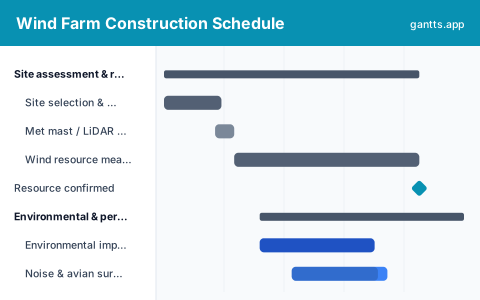
Wind projects spend years in development and months in construction. The template shows both, so the build sits in the context that actually determines when it can start:
- Site assessment & resource, Site selection, land agreements, met mast or LiDAR installation and at least twelve months of wind resource measurement. Milestone: resource confirmed.
- Environmental & permitting, Environmental impact assessment, noise and shadow-flicker modelling, avian and bat surveys, and planning consent. Milestone: consent granted.
- Grid connection, Connection application, system impact study, connection agreement and substation design, routinely the longest single item.
- Procurement, Turbine supply agreement, balance-of-plant contracting, transformer and cable orders against multi-month lead times.
- Civil works, Access roads and crane pads, foundation excavation, rebar and mass concrete pours, plus cable trenching.
- Erection & commissioning, Tower sections, nacelle and blade lifts, electrical termination, testing and grid energization. Milestone: first power.
Who uses this template
Wind developers, EPC contractors, and renewable project managers use this for onshore and offshore builds. It orders resource assessment, permitting, grid connection, turbine supply, foundations, erection, and commissioning, so long-lead turbine orders and grid approvals are placed early enough to keep the critical path to first power on track.
How to customize it
- Extend the resource measurement phase to at least twelve months, anything shorter will not satisfy a financier.
- Adjust the number of turbines; erection duration scales roughly linearly with the turbine count.
- Add weather standby days to the erection rows rather than assuming continuous lifting.
- Split civil works per turbine location if you need position-level tracking.
- Mark consent, financial close, first power and commercial operation as milestones.
Scheduling tips
- Grid connection usually sets the date. Connection queues and utility study timelines dominate the programme and are outside your control, put them on the chart early.
- Sequence crane movements deliberately. The main crane is the constraint on site; plan its walk order between positions instead of leaving it implicit.
- Watch blade logistics. Abnormal-load transport needs permits and route surveys, which fail late and expensively if left to the erection phase.
- Pour foundations well ahead of lifts. Mass concrete needs cure time before it can take a tower, so protect that gap.
- Baseline at financial close. Pre-consent dates are estimates; once funded, set a baseline and track variance against it.
Related templates
- Solar Farm Construction Schedule Template
- Free Construction Gantt Chart Template
- Project Management Gantt Chart Template
- Browse all Gantt chart templates
Frequently asked questions
How long does it take to build a wind farm?
Construction is typically 6-12 months, but the full programme from site assessment to first power commonly runs 3-7 years because resource measurement, permitting and grid connection dominate. The template lays out both stages.
What usually delays a wind project?
Grid connection and planning consent far more often than construction itself. Both depend on third parties, which is why they get their own phases here rather than being folded into a single development bar.
Can I use this for an offshore wind project?
Partly. The development and grid phases translate, but offshore adds vessel scheduling, port marshalling and marine weather windows that need extra rows.