
What's included
A bridge programme is governed by things you do not own: the river, the road below, the weather and the approving authority. The template gives each of them a visible place rather than burying them inside a construction bar:
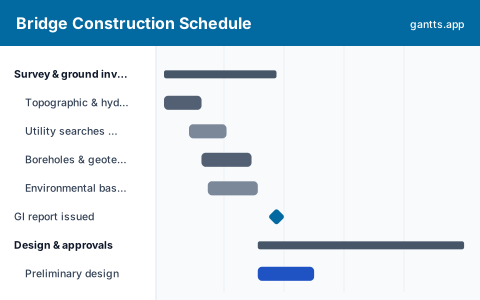
- Survey & ground investigation, Topographic and hydrographic survey, boreholes and geotechnical interpretation, utility searches and the environmental baseline. Milestone: GI report issued.
- Design & approvals, Preliminary and detailed design, temporary works design, technical approval by the highway or rail authority, environmental consents and river works licences. Milestone: technical approval.
- Enabling works & possessions, Site set-up, access roads and haul routes, utility diversions, cofferdams or causeway, and the booked road or waterway possession windows.
- Piling & foundations, Piling to each pier and abutment, pile testing, pile caps and foundation concrete, the operation most exposed to ground risk and river levels.
- Substructure, Abutments, wing walls, piers and pier caps, bearing plinths and bearing installation. Milestone: substructure complete.
- Superstructure & deck, Beam fabrication and delivery, crane or launch erection inside the possession, deck formwork, reinforcement and the deck pour.
- Surfacing, testing & opening, Waterproofing, surfacing, parapets and safety barriers, drainage, load testing, snagging and opening to traffic. Milestone: open to traffic.
Who uses this template
Civil engineers, site managers, and infrastructure contractors use a bridge schedule to plan spans from survey and approvals through piling, substructure, deck, and surfacing. It captures the sequential, weather-sensitive nature of the work and the load testing that precedes opening, helping teams manage float, inspections, and public traffic impacts.
How to customize it
- Enter the confirmed possession dates first and work backwards; almost every other date on a bridge programme negotiates around them.
- Add a row per pier and abutment once the substructure sequence is known, so piling and concrete pours are tracked individually.
- Mark weather-restricted operations, deck pours, waterproofing and surfacing all have temperature or rainfall limits worth showing.
- Extend the technical approval bar to your authority's real review period, including the response-to-comments loop.
- Keep temporary works design as its own task; falsework, cofferdam and launch scheme approvals gate the permanent works.
- Insert flood-season or fish-migration exclusion periods as blocked bars if you are working in a watercourse.
Scheduling tips
- Apply for possessions before design is finished. Lead times for road closures and rail possessions are measured in months, and slots are allocated to whoever booked first.
- Treat temporary works as permanent work. Falsework, cofferdams and launch systems need design, check and approval time, and they sit directly on the critical path to the deck.
- Do not schedule concrete pours you cannot heat or cool. Large deck pours pushed into deep winter routinely get abandoned on the morning; plan them into a workable season.
- Model the river, not the average. Foundation work in a watercourse should be scheduled around the historic high-water period, with float for a lost month rather than a lost week.
- Leave real time for load testing. Testing, instrumentation and the certification that follows are a gate to opening, not an inspection at the end.
- Baseline at technical approval. Everything before it is estimate; after it, track variance so scope changes from the authority are visible.
Related templates
- Free Construction Gantt Chart Template
- Mining Project Schedule Template
- 3-Week Lookahead Schedule Template
- Browse all Gantt chart templates
Frequently asked questions
How long does it take to build a bridge?
A small single-span highway bridge commonly runs 9-18 months from site start; a major river crossing runs several years. This template uses a roughly two-year programme you can compress or stretch by moving the opening date.
What usually delays a bridge project?
Ground conditions found during piling, technical approval loops with the highway or rail authority, and missed possession windows. All three are separate tracks here so the exposure is visible before it bites.
How do I show a road or rail possession on the chart?
Add the application, the confirmation and the window itself as three tasks, and make deck erection depend on the window. That way a slipped upstream activity visibly threatens a date you cannot move.
Does this work for a footbridge or a culvert replacement?
Yes. Keep the survey, approvals, foundations and superstructure phases and trim the pier rows, the sequence is the same at smaller scale.