
What's included
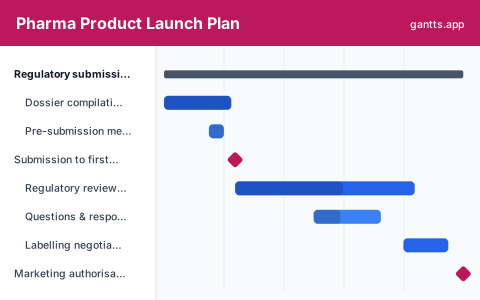
Everything commercial in a pharma launch is gated by two things you do not control: an approval letter and a reimbursement decision. The template puts both on the chart as bars with dependants, rather than as assumptions in a slide:
- Regulatory submission, Dossier compilation, pre-submission meeting, submission to the first market, the review clock, questions and responses. Milestone: marketing authorisation granted.
- CMC & manufacturing readiness, Process scale-up, site readiness, three validation batches, stability data, pre-approval inspection and release of launch stock. Milestone: launch stock released.
- Serialisation & labelling, Artwork per market, translations, serialisation and aggregation set-up, national repository connections and packaging qualification.
- Pricing & reimbursement, Health technology assessment dossiers, pricing strategy, payer negotiations and listing decisions per market, the phase that decides whether an approved product is actually available. Milestone: first reimbursement listing.
- Medical affairs & evidence, Publication plan, advisory boards, KOL engagement, medical education, real-world evidence and the medical information function.
- Commercial launch by country, Field force hiring and training, launch meeting, first market launch, then wave two and wave three markets as approvals and listings arrive. Milestone: first commercial sale.
Who uses this template
Pharma launch leads, regulatory affairs managers, and market-access teams use this to orchestrate a drug's path to market. It sequences regulatory submission and approval, validation batches, serialisation, pricing and reimbursement negotiations, and the country-by-country launch order, keeping supply, compliance, and commercial milestones synchronised.
How to customize it
- Set your submission date and let the review clock run forward from it; the regulator's duration is fixed, and only your response time inside it is yours.
- Duplicate the pricing, labelling and launch rows per market, since each has its own authority, language and reimbursement path.
- Start validation batches earlier if your process is new, three successful batches plus stability data is a long chain with no shortcut.
- Add a pre-approval inspection window with real preparation time; a site finding at inspection is the fastest way to lose a launch quarter.
- Push field force hiring to depend on the approval milestone unless you can carry the cost of a team waiting for a decision.
- Mark submission, approval, launch stock release, first reimbursement listing and first commercial sale as milestones.
Scheduling tips
- Build launch stock before approval, and accept the write-off risk consciously. Waiting for the letter before manufacturing adds months of empty shelf; committing early is a decision the board should make explicitly, not one the schedule makes by default.
- Run the reimbursement dossier in parallel with regulatory review. The evidence overlaps but the audience does not, and starting the payer work after approval is what turns a launch into a wait.
- Treat serialisation as a systems project. Market-specific coding, aggregation and repository connections need testing with real packs; it fails quietly and is discovered at the point of first shipment.
- Sequence markets deliberately. Early launch in a low-price reference market can anchor prices elsewhere for years, so the launch order is a commercial decision that belongs on the chart.
- Keep medical affairs ahead of commercial. Publications, advisory boards and education need lead time and cannot be compressed into the weeks after approval when promotional activity begins.
- Baseline at submission. Everything before it is a development estimate; after it, the schedule is a queue you can track precisely.
Related templates
- Clinical Trial Gantt Chart Template
- Free Product Launch Gantt Chart Template
- New Product Development Plan Template
- Browse all Gantt chart templates
Frequently asked questions
How long does a pharma product launch take?
Commonly 18-30 months from regulatory submission to first commercial sale, with review taking around a year in major markets and reimbursement adding several months on top. The template uses a roughly two-year schedule you can adjust per market.
Where does this template start relative to a clinical trial?
It picks up where the trial ends. Database lock, analysis and the study report belong in the clinical trial Gantt chart; this template starts with dossier compilation and runs to first sale.
Why are pricing and reimbursement a separate phase?
Because approval only grants the right to sell, not the ability to. Health technology assessment and payer negotiation are separate processes with their own timelines, and in most markets they determine when a product is genuinely available.
How do I plan a multi-country launch?
Duplicate the labelling, reimbursement and commercial launch rows per market and stagger them into waves. The template shows a first market plus two waves, which is the usual shape.
What is the risk of building stock before approval?
Write-off if the product is not approved or the label changes. Most launches accept some of that risk because manufacturing lead times exceed the gap between approval and expected first orders, but it should be a stated decision with a number attached.