
What's included
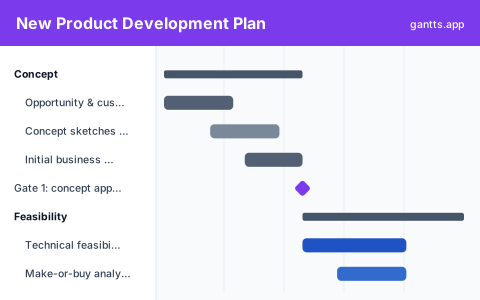
NPD schedules go wrong at the gates, not in the tasks. The template separates each stage so a gate is a decision with evidence behind it rather than a date that quietly passes:
- Concept, Opportunity definition, customer needs and requirements, concept sketches, initial business case and the concept gate. Gate 1: concept approved.
- Feasibility, Technical feasibility studies, make-or-buy analysis, regulatory scan, cost model and risk assessment. Gate 2: feasibility passed.
- Detailed design, System and detail design, design for manufacture and assembly, bill of materials, supplier engagement and the design review. Gate 3: design freeze.
- Prototyping, Alpha build, engineering evaluation, design iterations and the beta build used for validation.
- Validation & testing, Design verification, environmental and life testing, certification and compliance submissions, and user trials. Gate 4: design validated.
- Tooling & industrialization, Tool design and manufacture, first-article inspection, process development, fixtures and supplier qualification.
- Pilot production & handover, Pilot run, production part approval, ramp plan, documentation pack and handover to operations and the launch team. Gate 5: production release.
Who uses this template
R&D managers, product engineers, and stage-gate owners in hardware and consumer-goods companies rely on this to walk a concept from idea to market. It lays out feasibility, prototyping, design validation, tooling, and pilot production as gated phases, making it clear where a go/no-go decision sits and when engineering hands off to manufacturing.
How to customize it
- Set the required production release date and work backwards; tooling lead time usually decides whether the plan is possible at all.
- Order long-lead tooling against real quoted lead times and place the order task before the design freeze if you are taking that risk deliberately.
- Add a row per certification body if your product needs multiple approvals, they run in parallel and each has its own queue.
- Expand prototyping into as many builds as you actually need; two is optimistic for anything with moving parts.
- Keep supplier qualification visible, a qualified part from an unqualified supplier is not a releasable part.
- Mark all five gates as milestones so the steering group sees decisions rather than progress bars.
Scheduling tips
- Do not overlap tooling with design changes. Cutting steel before the design is frozen is the most common way an NPD programme spends its contingency in a single week.
- Start certification early. Test-house queues and regulatory review are third-party durations you cannot compress by working harder, so book slots as soon as a testable build exists.
- Give validation its own bar. Test time is real elapsed time, life testing in particular runs for weeks regardless of how many engineers you assign.
- Run supplier engagement during design, not after it. Manufacturability feedback arriving after design freeze becomes a change request rather than a design input.
- Separate this plan from the launch plan. Marketing dates should hang off production release, not off an engineering estimate made at concept stage.
- Baseline at design freeze. Track variance from the frozen design so late changes are visible as schedule cost, not absorbed silently.
Related templates
- Free Product Launch Gantt Chart Template
- Free Product Roadmap Gantt Chart Template
- Software Development Gantt Chart Template
- Browse all Gantt chart templates
Frequently asked questions
How is this different from the product launch template?
This one is the engineering pipeline that ends at production release, concept through tooling and pilot production. The product launch plan starts roughly where this ends and covers positioning, pricing, channel readiness and the go-to-market campaign.
How long does new product development take?
It varies with complexity: a straightforward consumer accessory may run 6-9 months, while a regulated or heavily tooled product commonly runs 18-36. The template uses an eighteen-month programme you can compress or extend.
What are the stage gates in this template?
Concept approved, feasibility passed, design freeze, design validated and production release. Each is a milestone with its evidence-producing tasks as predecessors.
Can I use it for a software product?
Partly, the concept, feasibility, design and validation phases transfer well, but you would drop tooling and pilot production. For software the software development plan is a closer fit.