
What's included
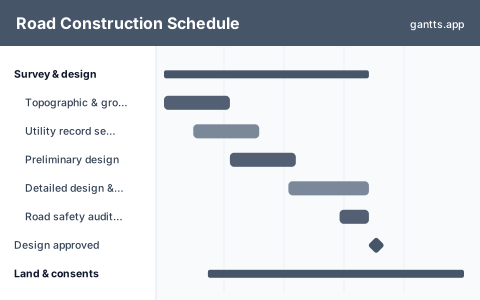
On a road scheme the pavement is the easy part. What controls the date is what has to move before you can dig: statutory undertakers' apparatus, land you do not yet own, and the traffic that has to keep flowing. The template gives each of those its own track:
- Survey & design, Topographic and ground investigation survey, utility record searches and trial holes, preliminary and detailed design, drainage design and road safety audit. Milestone: design approved.
- Land & consents, Land referencing, acquisition or temporary possession, planning consent, environmental approvals and side road orders. Milestone: consents in place.
- Utilities diversions, C3/C4 estimates from each statutory undertaker, diversion design, programming with the undertakers, and the diversions themselves, gas, water, power and telecoms, each on its own timeline.
- Traffic management, TM design and approval, road space booking, diversion route agreement, and the staged closures, contraflows and lane restrictions the works are built inside.
- Earthworks & drainage, Site clearance and topsoil strip, cut and fill, capping layer, carrier drains, gullies, attenuation and outfalls.
- Pavement construction, Sub-base, base course, binder course and surface course, kerbs, footways and ironwork adjustment. Milestone: surfacing complete.
- Signage, markings & handover, Road markings, signs and gantries, street lighting, safety fencing, final road safety audit, snagging and handover to the maintaining authority. Milestone: road open.
Who uses this template
Civil engineers, highway contractors, and roadworks project managers plan carriageway jobs with this. It orders survey, consents, utility diversions, earthworks, drainage, and pavement layers alongside traffic management, so lane closures and diversions are sequenced to keep the public moving while the works progress toward handover.
How to customize it
- Enter the confirmed road space booking dates first; on a live highway they are the fixed points the rest of the programme fits around.
- Add a row per statutory undertaker, gas, water, electricity and each telecoms operator have different notice periods and different crews.
- Split the scheme into sections or chainage ranges once the TM staging is known, so earthworks and pavement can be tracked per stage.
- Move surfacing out of the winter months where you can; binder and surface course laying has temperature limits that stop work on the day.
- Insert environmental exclusion periods, nesting season, bat activity, fisheries windows, as blocked bars if your consents impose them.
- Keep both road safety audits on the chart; the post-construction audit is a gate to opening, not a review afterwards.
Scheduling tips
- Request utility estimates during design. The C3 and C4 process alone can take months before a single diversion is dug, and it sits ahead of everything else on the critical path.
- Book road space before you need it. Highway authority permit and closure calendars are allocated first come first served, and a refused booking moves the whole stage.
- Sequence drainage before pavement, always. Retrofitting a missed gully or connection through a finished carriageway costs several times what it costs beforehand.
- Watch the weather windows on bound layers. Surface course laid below the specified temperature fails early, and the authority will not adopt it.
- Plan the TM stages as tasks with durations. Each changeover is a night's work with its own resources; treating staging as free is how programmes lose a fortnight.
- Baseline at consents in place. Before that the programme is conditional; after it, track variance so utility slippage is visible early.
Related templates
- Bridge Construction Schedule Template
- Free Construction Gantt Chart Template
- 3-Week Lookahead Schedule Template
- Browse all Gantt chart templates
Frequently asked questions
How long does a road construction project take?
A short urban improvement may run 6-9 months; a new link road or major widening runs two years or more. The template uses a roughly eighteen-month programme you can compress or extend from the opening date.
What usually delays road schemes?
Utility diversions and consents far more often than construction. Both depend on third parties with their own timescales, which is why each gets a separate track rather than a line inside the works.
How do I show traffic management on a Gantt chart?
As staged bars with the design and road space booking as predecessors, and each construction stage depending on its own TM stage. That way a refused or delayed booking visibly threatens the works it protects.
Does this cover a bridge or structure within the scheme?
Only at summary level. If your scheme includes a structure, run our bridge construction schedule alongside it and link the possession windows.
Can I use it for resurfacing rather than new construction?
Yes. Drop the land, consents and earthworks phases and keep traffic management, pavement layers and markings, that is the shape of a resurfacing programme.