
What's included
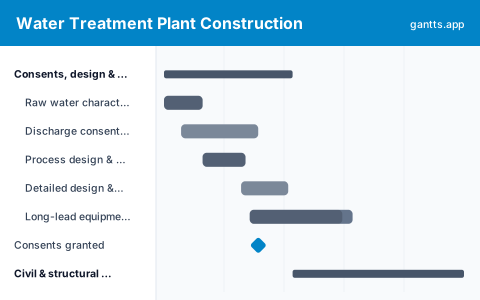
Every other building hands over when the snagging list is empty. A treatment works hands over when a regulator has watched it produce compliant effluent, continuously, for weeks. The template is built backwards from that:
- Consents, design & procurement — Raw water characterisation and pilot trials, process design and mass balance, detailed design, discharge consent and abstraction licence, and the long-lead equipment that fixes the installation dates. Milestone: consents granted.
- Civil & structural works — Earthworks and piling, inlet works, clarifiers, biological reactor basins, filter gallery and sludge structures — then hydrostatic leak testing on every tank. Milestone: structures watertight.
- Mechanical & electrical installation — Pumps and valves, blowers and the aeration diffuser grid, filter media, dosing skids, UV, switchgear and standby generation, and field instrumentation. Milestone: mechanical completion.
- Controls & clean-water testing — SCADA configuration, loop checks, no-load motor testing and functional testing on clean water — proving the control philosophy before any raw water enters the works.
- Wet commissioning & biological seeding — First raw water, seed sludge inoculation, biomass growth and MLSS build-up, nitrification establishment and sludge-age tuning. Milestone: stable biological process confirmed.
- Performance test & handover — Ramp to design flow, the sustained witnessed performance test, compliance sampling, a reliability run at peak flow, operator training and takeover. Milestone: takeover certificate.
How to customize it
- Set the seeding and biomass build-up bars from your process designer's figures and your expected commissioning season — a winter start can add several weeks to nitrification alone.
- Change the witnessed performance test to the duration written in your contract and consent; 28 days is common but many schemes require longer or a repeat if a sample fails.
- Add a resample-and-retest bar after the performance test. Assuming first-time pass is the single most common scheduling error on these jobs.
- Split hydrostatic testing into a row per tank if you are filling them in sequence, and remember failed tanks need drying, repair and a repeat fill.
- Move SCADA configuration earlier — it depends on the P&IDs, not on the concrete, and it is routinely started far too late.
- Mark consents granted, structures watertight, mechanical completion, first raw water and takeover as milestones; those are the dates a client board and a regulator both track.
Scheduling tips
- Give the regulator formal notice of your test start date well before you need it. Witnessing requires their diary, not yours, and a slipped notification can push handover by a month even if the plant is ready.
- Source your seed sludge early and in writing. It comes from another operating works, needs a tanker fleet and a delivery window, and a plant sitting full of raw water waiting for inoculum is burning float for nothing.
- Prove the controls on clean water first. Chasing a bad level transmitter or an inverted valve action while a biological process is trying to stabilise costs far more than the fortnight the clean-water phase takes.
- Do not overlap the performance test with outstanding works. A contractor still fitting handrails during a witnessed test gives the regulator an easy reason to invalidate the run.
- Watch the effluent consent, not the flow meter. Hitting design flow proves the hydraulics; only sustained compliant sampling proves the process, and only the second one gets you a certificate.
- Train operators during commissioning, not after. The commissioning team is the only group that will ever see the plant in every failure mode, and that knowledge walks off site with them.
Related templates
- Road Construction Schedule Template
- Bridge Construction Schedule Template
- Free Construction Gantt Chart Template
- Browse all Gantt chart templates
Frequently asked questions
How long does it take to build a water treatment plant?
A medium municipal works commonly runs 24–36 months from consent to takeover, and the template uses roughly that. The civils are predictable; the variance sits in consents at the front and commissioning at the back.
Why does commissioning take so long?
Because a biological treatment process is grown, not switched on. Seeding, biomass build-up and nitrification establishment take weeks, and only after the process is stable can a sustained performance test start.
What is a witnessed performance test?
A continuous run at design flow during which the works must produce effluent inside its consent limits, sampled and observed by the client and regulator. Passing it — not finishing construction — is what triggers handover.
Can we shorten commissioning by seeding earlier?
Only slightly. You can pre-order seed sludge and have tankers ready the day raw water is introduced, but the growth curve itself is biology. Compressing the programme has to come from the civils and installation phases.
How do I schedule around a failed compliance sample?
Add a contingency bar for resampling and, in many contracts, a full repeat of the test period. Building the schedule on a first-time pass is how these projects overrun at the very last gate.
Is the water treatment plant template free?
Yes. Free Excel, PowerPoint and CSV downloads, and free online editing with no account and no watermark.