
What's included
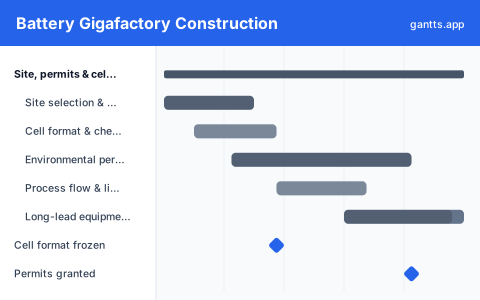
A cell plant is not finished when the roof is on. It is finished when cells come off the line at a yield somebody will pay for, and the route there runs through a controlled environment. The template follows that route:
- Site, permits & cell process design, Site and grid connection, the cell format and chemistry freeze that fixes every downstream machine, environmental and hazardous-materials permitting, the process flow and line capacity basis of design, and the long-lead equipment orders. Milestones: cell format frozen, permits granted.
- Building shell & dry room construction, Piling, slab and steel, envelope and dry-in, then the vapour barrier and sealed dry room envelope, airlocks and gowning, and the floor flatness the coating and calender lines demand. Milestone: building dry-in complete.
- Utilities, dehumidification & dry room qualification, Substation and distribution, the desiccant dehumidification plant, compressed dry air, nitrogen and process cooling, solvent recovery and abatement, then pull-down to dew point and a hold test that proves the envelope. Milestone: dry room qualified at dew point.
- Equipment move-in, install & qualification, Coater and calender, slitting, vacuum drying and winding, stacking, tab welding and sealing, electrolyte filling and degassing, formation and aging racks, then station-by-station acceptance testing. Milestone: equipment qualification complete.
- Line commissioning, first cell & formation, MES and traceability integration, coating trials and web quality tuning, dry room operating discipline, the first assembled cell, then formation cycling, the aging and self-discharge window, and the teardown and failure-analysis loop. Milestone: first cell off the line.
- Yield ramp & customer qualification, Process capability and SPC per station, scrap reduction from electrode to assembly, A-samples out, abuse and transport testing, B-sample qualification and PPAP, then the ramp to nameplate. Milestones: yield target reached, start of production.
Who uses this template
Owners, EPC contractors, and commissioning teams building lithium-ion cell plants use this schedule to coordinate the hardest parts of the ramp. It sequences dry-room qualification, equipment installation and qualification, and formation and aging against the yield-ramp curve, aligning civil, process, and manufacturing teams whose dependencies decide when the factory reaches volume production.
How to customize it
- Freeze the cell format and chemistry early and mark it as a milestone. Coater width, calender load, can dimensions, formation rack layout and the whole utility sizing derive from it, and a late change is a redesign, not a tweak.
- Give dew point pull-down and the hold test their own bars after the dehumidification plant is installed. A plant that runs is not the same as an envelope that holds, and the leak survey is where late envelope defects surface.
- Sequence tool move-in against dry room readiness rather than against vendor delivery dates. Equipment sitting in a crate outside a room that has not reached dew point qualifies nothing.
- Model formation and aging as fixed-duration bars per batch, not as capacity you can add crew to. The chemistry sets the days; the only lever is how many racks you own.
- Draw the yield ramp as a long bar with a target milestone at the end rather than as a step change. Everything after first cell is a learning curve, and drawing it as an event hides months of real work.
- Split equipment qualification from line commissioning. A vendor proving a station runs to spec and your process team proving the line makes a good cell are different events with different owners.
Scheduling tips
- Build the dry room before you need it, not when the tools arrive. Envelope sealing, airlocks and pull-down are sequential and slow, and every day of that chain sits directly in front of first cell.
- Buy formation and aging capacity, not schedule. If the aging window is three weeks per batch, the only way to shorten the ramp is more racks and more floor, no amount of resequencing changes the chemistry.
- Treat solvent recovery and abatement as critical path. They are unglamorous, routinely deprioritised, and no coating line can run in production without them.
- Track scrap rate by station from the first trial. A single station running badly upstream throws away material that has already had value added to it, and it is the most common reason a ramp stalls.
- Start customer qualification before you think you are ready. Abuse testing, transport certification and PPAP take months of elapsed time and can run against early cells while yield is still improving.
- Put dry room discipline on the chart as training, not as a memo. Gowning, material entry and moisture control are habits that take weeks to embed, and a humid excursion costs more than the training would have.
Related templates
- Semiconductor Fab Construction Schedule Template
- Manufacturing Production Schedule Template
- Wind Farm Construction Schedule Template
- Browse all Gantt chart templates
Frequently asked questions
How long does it take to build a battery gigafactory?
A greenfield cell plant commonly runs 30-36 months from permits to start of production, which is roughly the span the template uses. The shell is predictable; dry room qualification, equipment qualification and the yield ramp carry the variance.
Why does the dry room dominate the schedule?
Electrode handling and cell assembly need extremely low humidity, so the building has to be sealed, vapour-barriered and desiccant-dried before tools can be set. That turns a construction sequence into a controlled-environment sequence months before any equipment arrives.
Can formation and aging be compressed?
No. Each cell needs a set number of hours or days of controlled charging and then a rest period for self-discharge screening. The only lever is more formation and aging capacity, which is capital and floor space, not scheduling.
What actually gates saleable output?
Equipment qualification and yield, not building completion. A finished factory with unqualified stations produces nothing sellable, which is why the template puts the qualification milestone well after fit-out.
How should the yield ramp be shown on a Gantt chart?
As a long bar with a target milestone at the end. Defect reduction is a curve driven by experiments, and drawing it as a single event is the most common way gigafactory schedules mislead their own boards.