
What's included
Change management is usually drawn as a box labelled "training" next to go-live. It is not one box. It is a workstream with its own dependencies, and the half that matters most starts the week after launch:
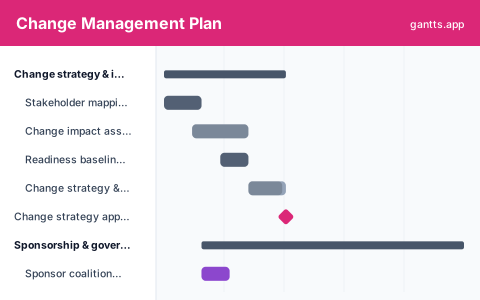
- Change strategy & impact assessment, Stakeholder mapping, a change impact assessment by affected group, a readiness baseline, and the strategy that sets how much support each group needs. Milestone: change strategy approved.
- Sponsorship & governance, The sponsor coalition, commitment sessions, champion recruitment and onboarding, the first sponsor roadshow, and a resistance log that is actually worked rather than filed. Milestone: change network live.
- Communications, A communications plan by audience, the case for change and FAQ, awareness campaign, manager briefing packs, role-level "what changes for me" guides, and the go-live sequence.
- Training, Needs analysis by role, curriculum build, train-the-trainer, then cohorts run in waves with the final one landing close to go-live so people use what they were taught. Milestone: training complete.
- Go-live readiness & support, Readiness assessment by business unit, a second sponsor roadshow, the floor-walker and superuser rota, readiness sign-off and hypercare. Milestone: go-live.
- Reinforcement & sustainment, Adoption metrics, pulse surveys at week two and month three, targeted refresher training, manager coaching, recognition, and the benefits review. Milestone: handover to business as usual.
Who uses this template
Change managers, transformation leads, and HR business partners use this plan alongside a major system rollout or reorganization. It times impact assessments, sponsor roadshows, communications, and training cohorts to the go-live moment, then carries the effort through hypercare and reinforcement so adoption sticks rather than fading once the project team disbands.
How to customize it
- Set go-live first, then place the final training cohort a few days before it and work every other cohort backwards from there.
- Add one impact assessment row per affected group; a shared services team and a field engineer do not experience the same change.
- Size the champion network to roughly one champion per team, and make their time an agreed allocation rather than a favour.
- Add sponsor roadshow rows per region or business unit if the sponsor cannot cover everyone in one round.
- Extend hypercare for shift-based or seasonal operations so every shift pattern gets support during its first live week.
- Keep the pulse surveys and refresher training as dated rows after go-live, they are the rows most often deleted and the ones that determine adoption.
Scheduling tips
- Impact assessment before communications. You cannot tell someone what changes for them until you have worked out what changes for them, and generic messaging is what makes people assume the change is not for them.
- Sponsors have to be visible, repeatedly. One launch email is a memo. A roadshow before and after go-live is a signal that the change is not optional.
- Brief managers separately and earlier. Their team will ask them first, and a manager who does not know the answer becomes an accidental source of resistance.
- Work the resistance log. Resistance is information about a real problem far more often than it is obstruction, and the log is where you notice the same objection appearing in five teams.
- Measure adoption, not attendance. Training completion says nothing. Pulse surveys and usage behaviour tell you where to send the refresher sessions.
Related templates
- Free Employee Onboarding Gantt Chart Template
- ERP Implementation Schedule Template
- CRM Implementation Plan Template
- Browse all Gantt chart templates
Frequently asked questions
When should change management start?
At the same time as the technical project, not near go-live. Impact assessment needs the design to be understood but has to finish early enough to shape communications and training. The template starts on day one and runs about five months past launch.
How is this different from a project plan?
A project plan delivers the system. This delivers the people's ability and willingness to use it. They share a go-live date and almost nothing else, which is why change management works best as its own chart with its own owner, laid alongside the delivery schedule.
When should training happen?
As late as possible without colliding with cutover. Skills decay, so a cohort trained six weeks early is retrained informally at go-live. Run waves, put a pilot cohort early enough that its feedback can improve the material, and land the final cohort days before launch.
What happens after go-live?
The part most plans cut: hypercare, a pulse survey at about week two, targeted refresher training aimed at whatever the survey found, manager coaching, and a benefits review. Behaviour change happens in the weeks after launch, not before it.
Do I need a separate change plan for a small project?
Not always, but you still need the sequence. For a smaller change, keep impact assessment, manager briefings, one training wave and a post-launch pulse, and drop the champion network and roadshow rows.