
What's included
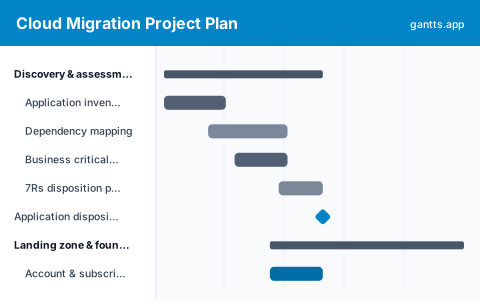
Cloud migrations are not one project, they are a foundation build plus a repeating wave. The template separates the two so the landing zone is finished before the waves depend on it:
- Discovery & assessment, Application inventory, dependency mapping, business criticality, and a 7Rs disposition per workload, rehost, replatform, refactor, repurchase, relocate, retire, retain. Milestone: application dispositions agreed.
- Landing zone & foundation, Accounts and subscriptions, network and connectivity, identity, security guardrails, logging and the cost model. Everything downstream depends on this. Milestone: landing zone live.
- Wave planning & pilot, Grouping applications into waves by dependency rather than by team, then proving the runbook on a low-risk pilot wave.
- Migration waves, Repeating build, migrate, test, cutover cycles per wave. The pattern is the same each time; what changes is the risk profile.
- Cutover & hypercare, Production cutovers, DNS and traffic switch, rollback windows and the elevated-support period after each wave. Milestone: production cutover complete.
- Decommission & optimize, Turning off the source estate, exiting the data centre or hosting contract, then right-sizing and reserved-capacity commitments. This is where the business case is actually realized.
Who uses this template
Cloud architects, infrastructure leads, and migration program managers use this plan to move workloads to AWS, Azure, or Google Cloud. It runs from discovery and landing-zone build through migration waves, cutover, and hypercare to data-center decommission, sequencing application waves by dependency and risk so the business keeps running throughout the move.
How to customize it
- Fix the data centre exit or hosting contract end date first and work backwards, that date is usually contractual and non-negotiable.
- Add one row per application once the inventory is done, grouped under the wave that carries it.
- Duplicate the wave phase for each additional wave; the internal shape stays identical.
- Move refactor candidates out of the wave plan entirely, they are development projects, not migrations, and mixing them ruins the wave cadence.
- Mark landing zone live, pilot wave complete, each production cutover and source decommission as milestones.
Scheduling tips
- Do not start waves before the landing zone is finished. Migrating into a foundation that is still changing means re-migrating, and it is the most common source of rework on these programmes.
- Group waves by dependency, not by department. Applications that talk to each other should move together, or you will pay for the latency between two estates while they are split.
- Run a real pilot wave. Its purpose is to prove the runbook and expose the surprises, so pick applications that are low risk but genuinely representative, not the easiest three on the list.
- Budget for parallel running. Both estates run at once for the length of the migration; that overlap cost is real and belongs in the business case from day one.
- Keep a rollback window on every cutover. A cutover without a documented and rehearsed rollback is a one-way door taken without deciding to take it.
Related templates
- ERP Implementation Schedule Template
- Software Development Gantt Chart Template
- Data Center Build Schedule Template
- Browse all Gantt chart templates
Frequently asked questions
How long does a cloud migration take?
Commonly 9-24 months for a mid-sized estate, driven mainly by application count, dependency complexity and how much refactoring is in scope. The template uses a roughly fifteen-month schedule you can compress or extend.
What are the 7Rs of cloud migration?
Rehost, replatform, refactor, repurchase, relocate, retire and retain, the disposition options assigned to each application during assessment. Getting these decided early is what makes wave planning possible.
How should migration waves be sequenced?
By dependency group first, then by risk. Applications that share data or call each other should move in the same wave, and the pilot wave should be low risk but representative enough to prove the runbook.
Does this cover decommissioning the old environment?
Yes, it is a full phase, because it is where the savings in the business case actually land and it is the phase most often abandoned once the last cutover is done.