
What's included
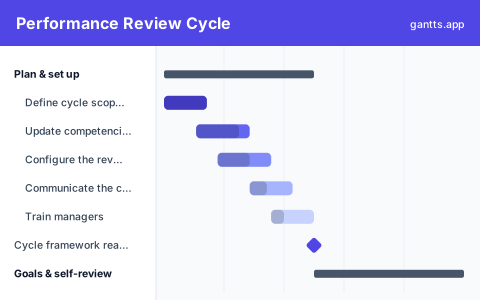
Performance reviews go wrong when the stages overlap: managers writing reviews before self-assessments are in, or ratings delivered before calibration. This template lays the whole cycle on one timeline, in the six stages a review process runs through, annual, bi-annual or quarterly:
- Plan & set up, Define the cycle scope and timeline, update the competencies and rating scale, configure the tool, communicate to the org, and train managers. Milestone: cycle framework ready.
- Goals & self-review, Confirm the goals under review, collect employee self-assessments and 360/peer feedback, and gather the supporting performance data. Milestone: self-reviews in.
- Manager reviews, Managers write their reviews, draft ratings against the scale, and get a one-up review before ratings go to calibration. Milestone: draft ratings ready.
- Calibration, Prepare the calibration data, run the calibration sessions to normalise ratings across teams, and finalise ratings and comp/promotion decisions. Milestone: ratings finalised.
- Delivery, Prepare the review packets and deliver the reviews in 1:1 conversations. Milestone: reviews delivered.
- Development & close, Set next-cycle goals, agree development plans, gather feedback on the process, and close and report on the cycle. Milestone: cycle closed.
Who uses this template
HR and people teams, and the managers and leaders who run reviews, use this plan to run a performance review cycle without the stages colliding: self-assessments in before manager reviews, and ratings calibrated before they are delivered. It fits annual, bi-annual or quarterly cycles, from the competency framework and manager training through self-review, calibration and 1:1 delivery to development planning.
How to customize it
- Set your delivery deadline first and work backwards; a full cycle needs six to ten weeks once self-reviews, manager reviews and calibration are sequenced properly.
- Keep self-assessment strictly before manager reviews, the whole point is that managers write with the employee’s input in hand, not after the fact.
- Add a row per team or department under manager reviews and calibration so a large org shows each group’s progress.
- For quarterly cycles, compress the same six phases; for annual cycles, give calibration and delivery more room.
- Mark “self-reviews in”, “draft ratings ready” and “ratings finalised” as milestones so you can see whether delivery can start on time.
Scheduling tips
- Self-reviews gate manager reviews. Managers should write with the self-assessment and peer feedback already in; sequence the phases so no review is drafted before its inputs are in.
- Calibration is the step that makes ratings fair. Normalising ratings across teams before delivery is what stops one lenient or harsh manager from skewing outcomes; never deliver an un-calibrated rating.
- Ratings are irreversible once delivered. Treat “ratings finalised” as a hard gate, a number shared in a 1:1 and then changed in calibration destroys trust in the whole process.
- Train managers before the cycle opens. Consistent write-ups and ratings depend on managers understanding the scale and criteria up front, not learning them mid-cycle.
- Close the loop with development plans. The review is the input, not the output; schedule next-cycle goals and development plans so the cycle drives growth rather than just a rating.
Related templates
- Free Employee Onboarding Gantt Chart Template
- OKR Quarterly Planning Template
- Training Program Rollout Plan Template
- Browse all Gantt chart templates
Frequently asked questions
How long does a performance review cycle take?
A full cycle typically runs six to ten weeks from opening the framework to delivering reviews, longer for large organisations because calibration and delivery scale with headcount. The template spreads set-up, self-review, manager reviews, calibration, delivery and development across a timeline so you can see whether your dates are realistic.
What are the stages of a performance review cycle?
Most cycles run through six stages: framework and manager training, self-assessment and 360 feedback, manager reviews and draft ratings, calibration, delivery in 1:1s, and development planning. The template gives each its own phase with milestones, and works for annual, bi-annual or quarterly cycles.
Can I show dependencies between review-cycle tasks?
Yes. Open the template in the free gantts.app editor to link finish-to-start relationships (self-reviews → manager reviews → calibration → delivery) so if self-assessments run late, everything after shifts automatically and your critical path to review delivery stays visible.