
What's included
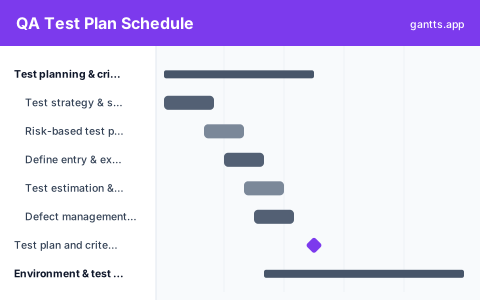
Notice that the execution bars overlap and that the defect loop runs the full length of them. That is what a real test schedule looks like:
- Test planning & criteria, Test strategy, scope and risk-based prioritisation, the entry and exit criteria for each phase written down before execution starts, estimation and the resourcing plan. Milestone: test plan and criteria approved.
- Environment & test data readiness, The real gate. Environment build, configuration and integration stubs, test data provisioning and masking, access and accounts, and a smoke test that proves the environment before anyone tests in it. Milestone: environment entry criteria met.
- Test design & automation, Test condition and case design, traceability back to requirements, the automation framework, regression suite build and the performance test scripts. Milestone: test cases ready for execution.
- Execution, unit, integration, system, Overlapping execution waves rather than a queue: unit and component testing, integration and interface testing, then system and security testing. Milestone: system test exit criteria met.
- Defect triage, fix & retest loop, The loop that actually consumes the calendar, daily triage, severity assignment, fix cycles, retest and regression impact, and the deferred defect decisions. Milestone: defect thresholds met.
- UAT, regression & release readiness, User acceptance testing by business users, full regression, performance and load runs, the release readiness review and sign-off. Milestone: release sign-off.
Who uses this template
QA leads, test managers, and release engineers use this to schedule a testing cycle before a release. It sets entry and exit criteria, environment and test-data readiness, overlapping functional and integration phases, the defect triage loop, and final regression, helping teams see whether testing actually fits inside the release window.
How to customize it
- Write actual entry and exit criteria into the notes on each phase row, pass rate, open defect count by severity, coverage, so the gates are checkable rather than rhetorical.
- Overlap the execution waves to match your build cadence; queueing them end to end almost always overstates the total duration and understates the risk.
- Size the defect loop from your historical defect discovery and fix rates, not from a percentage of test effort.
- Add a row per interface or integrated system if integration testing depends on partners who control their own environments.
- Move UAT earlier per module if you release incrementally rather than in one drop.
- Add a code freeze row before regression, and keep regression after it, regression against a moving build is not regression.
Scheduling tips
- Make exit criteria numeric. "Testing complete" is not a gate; "zero open severity 1, fewer than five severity 2, 95% of planned cases executed" is.
- Provision test data before test design finishes. Designers discover data gaps, and data provisioning has the longest lead time of anything in the plan.
- Triage daily during peak execution. A weekly triage meeting means a defect can sit five days before anyone decides who fixes it.
- Protect regression from the fix stream. Every late fix invalidates part of the regression run, which is why the code freeze row exists.
- Track defect discovery rate, not defect count. A falling discovery rate is the honest signal that a phase is converging; a raw count tells you almost nothing.
Related templates
- Software Development Gantt Chart Template
- Free Sprint Planning Gantt Chart Template
- Mobile App Launch Plan Template
- Website Redesign Project Plan Template
- Data Migration Project Plan Template
- Browse all Gantt chart templates
Frequently asked questions
What are entry and exit criteria in a test plan?
Entry criteria are the conditions that must be true before a test phase may begin, environment stable, build deployed, test data loaded, smoke test passed. Exit criteria are the conditions that must be true before it may be declared finished, execution coverage, pass rate, and open defect counts by severity. Both should be numeric, agreed before execution starts, and enforced.
Why do test phases overlap instead of running in sequence?
Because builds arrive incrementally. Integration testing can start on the modules that are already unit tested, and UAT can begin on completed journeys while system testing continues elsewhere. Queueing phases end to end inflates the schedule and hides the real constraint, which is usually the fix and retest loop.
How long should I allow for defect fixing?
Size it from your own history: defects found per test day, the proportion that need a fix, and your average fix-plus-retest turnaround. On most projects the loop is the longest bar on the chart. Allocating a flat percentage of test effort is the usual way schedules slip.
What if the test environment is not ready?
Do not start execution. Testing against an unstable environment produces environment defects, not product defects, and the time is unrecoverable. The template makes environment readiness a gated milestone with a smoke test in front of it precisely so that this decision is visible rather than absorbed silently.
When should UAT start?
After the system test exit criteria are met for the scope UAT will cover, not after all system testing everywhere is done. UAT is business validation, so it needs a stable build and real-shaped data; running it against a build still receiving fixes wastes business users, who are the scarcest resource in the plan.