
What's included
A tunnel programme is not a sequence of trades. It is one machine moving forward at a rate the ground allows, with everything else arranged to keep it moving. The template is organised that way:
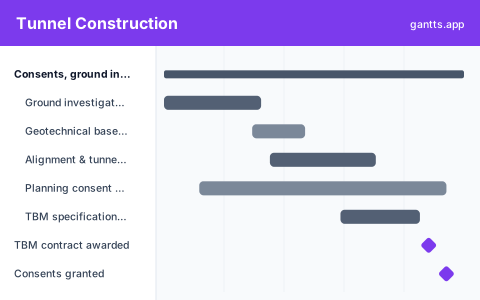
- Consents, ground investigation & procurement, Boreholes and the geotechnical baseline report, alignment and lining design, the planning consent or statutory order, and the TBM tender that fixes every downstream date. Milestones: consents granted, TBM contract awarded.
- Launch shaft & site establishment, Compound, diaphragm walls, shaft excavation, base slab and the thrust wall and launch chamber, plus the segment production run that has to be ahead of the machine on day one. Milestone: launch shaft ready to receive TBM.
- TBM manufacture, delivery & assembly, Cutterhead design for the expected ground, manufacture, factory acceptance test, shipping in sections, lowering down the shaft and underground assembly. Milestone: TBM ready to launch.
- Tunnel drive, Launch through the soft eye, the learning-curve first few hundred metres, sustained drive through mixed ground, a hyperbaric intervention for tool changes, the river crossing, and the constant background of settlement monitoring, segment supply and spoil haulage. Milestone: breakthrough.
- Cross-passages & secondary works, Ground treatment and cross-passage excavation while the machine is still ahead of you, TBM disassembly and removal, annulus grouting, ring survey and the secondary lining. Milestone: tunnel structurally complete.
- Fit-out, systems & commissioning, Walkway and drainage, cable containment, ventilation fans and ductwork, fire main and suppression, power and lighting, comms and SCADA, then a hot smoke test with the emergency services and the safety case. Milestone: handover for operation.
Who uses this template
Tunnelling engineers, underground construction managers, and major-infrastructure planners use this for bored and mined tunnels. It tracks TBM manufacture and delivery, the launch shaft, advance rates, cross-passages, breakthrough, and fit-out, so the long lead on a tunnel boring machine and steady daily progress are planned around one of the costliest items in the programme.
How to customize it
- Set your advance rate from the geotechnical baseline report, not from the best week on your last job, then split the drive into separate bars per ground unit so a bad reach is visible rather than averaged away.
- Give the first few hundred metres its own short, slow bar. Every TBM has a learning curve while the crew, the grouting and the spoil system settle down, and planning it at full rate is a guaranteed early slip.
- Add a hyperbaric intervention bar wherever the baseline predicts abrasive ground. Cutter tool changes are planned events with a known duration; discovering them mid-drive is what turns them into a month.
- Model segment supply as a continuous bar running the length of the drive, and check the casting yard output against your peak weekly ring count rather than the average.
- Show muck removal and the spoil disposal route explicitly. A full spoil bin or a lost tip licence stops the machine as effectively as a mechanical failure.
- Mark consents granted, TBM contract awarded, launch shaft ready, TBM ready to launch and breakthrough as milestones, those five dates are the whole programme in summary.
Scheduling tips
- Buy the machine before you finish the design of everything else. The cutterhead configuration depends on the ground, not on the station architecture, and the baseline report is usually enough to place the order a long time before the rest of the design is fixed.
- Treat the launch shaft as the critical path it is. Diaphragm walls, excavation, base slab and thrust wall are all sequential and all in soft ground; there is no way to compress the end of that chain to catch a late start.
- Never plan cross-passages behind the machine as filler work. They need ground treatment, they are the highest-risk activity on most tunnel jobs, and they have their own dependency on the rings being complete and grouted through that reach.
- Keep settlement monitoring running from before the launch to well after the drive passes. Baseline readings taken after tunnelling starts are worthless, and a compensation grouting response has to be instrumented before it is needed.
- Breakthrough is not the end. On most schemes the fit-out, ventilation and fire systems after breakthrough take longer than people expect, and the hot smoke test and safety case sit behind everything on the critical path to opening.
- Book the emergency services for the fire drill months in advance. A hot smoke test needs their attendance, and their diary is not yours, a missed slot can push a handover by weeks with the tunnel physically finished.
Related templates
- Bridge Construction Schedule Template
- Road Construction Schedule Template
- Rail Signalling Upgrade Plan Template
- Browse all Gantt chart templates
Frequently asked questions
How long does it take to build a tunnel?
A single-bore urban tunnel of a few kilometres commonly runs 30-40 months from consent to handover, which is roughly what the template uses. The variance is in TBM lead time at the front and ground conditions during the drive.
How far ahead should I order the TBM?
Design, manufacture, factory acceptance and shipping typically take 12-18 months for a bespoke machine, and assembly underground adds more. The order has to be placed while the shaft is still being designed, not when it is finished.
How do I schedule an advance rate I cannot predict?
Split the drive into bars per ground unit from the geotechnical baseline report and give each one its own rate. That way a slow reach shows as a slow reach rather than being hidden in a single averaged bar.
Why does the schedule slow down at the start of the drive?
Every drive has a learning curve. The crew, the ring build cycle, the grouting and the spoil handling all take a few hundred metres to settle, and planning the first weeks at full production rate is a common early overrun.
When should cross-passages be built?
After the machine has passed and the rings through that reach are grouted, but usually while the drive continues ahead. They need ground treatment first and they carry the highest risk on the job, so they get their own bars rather than being treated as float-filling work.